Popular Works of Art in the 19th Century Prior to Wwi

Military machine art is art with a military subject area matter, regardless of its style or medium. The boxing scene is one of the oldest types of art in developed civilizations, as rulers have e'er been peachy to celebrate their victories and intimidate potential opponents. The depiction of other aspects of warfare, especially the suffering of casualties and civilians, has taken much longer to develop. Also as portraits of war machine figures, depictions of anonymous soldiers away from the battlefield have been very common; since the introduction of military uniforms such works often concentrate on showing the diversity of these.
Naval scenes are very mutual, and boxing scenes and "ship portraits" are generally considered as a branch of marine art; the development of other large types of military equipment such as warplanes and tanks has led to new types of work portraying these, either in action or at residual. In 20th century wars official war artists were retained to depict the armed services in action; despite artists now being very close to the action the boxing scene is by and large left to popular graphic media and the movie theatre. The term state of war art is sometimes used, mostly in relation to 20th century military fine art made during wartime.[1]
History [edit]
Ancient world [edit]

Art depicting military themes has existed throughout history.[two] The Battleground Palette, a cosmetic palette from the Protodynastic Period of Egypt (circa ~3500 to 3000 BC) is incomplete, but shows prisoners being led away, and wild animals feasting on the expressionless. The Narmer Palette from the same menses shows a military machine victory in a more than symbolic style. The Stele of the Vultures, near 2,500 BC, is one of a number of Mesopotamian "victory stelae". Also around ii,500 BC, the earliest known depiction of a city beingness besieged is found in the tomb of Inti, an official from the 21st nome of Upper Egypt, who lived during the tardily Fifth Dynasty.[iii] The scene shows Egyptian soldiers scaling the walls of a near eastern fortress on ladders.[4] Although the Battle of Kadesh in 1274 BC appears to have been inconclusive, reliefs erected by Ramesses II testify him scattering his Hittite opponents with his chariot.
Surviving Assyrian art mainly consists of large rock reliefs showing detailed scenes of either military campaigns or hunting; the Lachish reliefs are an example of the old. The ancient Greek Parthenon Marbles show lengthy parades of the city'due south volunteer cavalry force, and many Greek vases prove scenes of combat. In Han dynasty China, a famous stone relief of c. 150-170 AD from the Wu family shrines shows a battle between cavalry forces in the Entrada against Dong Zhuo.[five]
In Ancient Roman art the most elaborate Roman triumphal columns showed very long reliefs of military machine campaigns winding round the body of huge columns; amidst the most impressive are those of Trajan and Marcus Aurelius in Rome. The Alexander Mosaic is a large and dramatic battle scene showing Alexander the Great defeating Darius Iii of Persia; it is a flooring mosaic excavated from Pompeii, probably copying a lost painting.[6] Many Hellenistic and Roman sarcophagi showed crowded scenes of combat, sometimes mythological (an amazonomachy is a term for a scene of battle between Amazons and Greeks), and usually not relating to a particular battle; these were not necessarily used to bury people with military experience. Such scenes had a keen influence on Renaissance battle scenes.[7] By the Belatedly Roman Empire the reverse of coins very often showed soldiers and carried an inscription praising 'our boys', no uncertainty in hope of delaying the next military defection.
Medieval [edit]

Christian art produced for the church generally avoided boxing scenes, although a rare Late Antique motif shows Christ dressed every bit a victorious emperor in general'due south apparel, having conquered the devil, in Christ treading on the beasts and other iconographies. The fierce tastes of the Anglo-Saxon elite managed to add the Harrowing of Hell, conceived every bit a raid on Satan's stronghold, led past Christ, to the standard group of scenes for a cycle on the Life of Christ.[8] Soldier saints, shown in armed forces apparel, were extremely popular, as were images of the Archangel Michael stabbing Satan as a dragon with a cross with a spear-point at its base. Some illuminated manuscripts illustrated the many battles in the Old Testament.
Secular works produced for secular patrons oft show war machine themes, for instance in illuminated manuscript copies of histories like the 15th century Froissart of Louis of Gruuthuse (BnF Fr 2643-half-dozen), where most of the 112 miniatures show war machine scenes. The Siege of the Castle of Love, often found on Gothic ivory mirror-cases, showed knights attacking a castle defended by ladies, a metaphor from the literature of courtly love. The 11th century Bayeux Tapestry is a linear panoramic narrative of the events surrounding the Norman Conquest and the Battle of Hastings in 1066,[9] the just surviving example of a blazon of embroidered hanging with which rich Anglo-Saxons used to decorate their homes. In Islamic art the boxing scene, often from a fictional work of epic poetry, was a frequent subject area in Western farsi miniatures, and the loftier viewpoint they adopted fabricated the scenes more hands comprehensible than many Western images.
Renaissance to Napoleonic Wars [edit]
Italian Renaissance painting saw a groovy increase in armed forces art by the leading artists, battle paintings often featuring near-contemporary scenes such as the huge set of three canvases of The Battle of San Romano (c. 1445) by Paolo Uccello, and the abortive Battle of Cascina (1504–06) by Michelangelo and Boxing of Anghiari by Leonardo da Vinci (1503–06), which were intended to be placed opposite each other in the Palazzo Vecchio in Florence, but neither of which were completed. For Renaissance artists with their new skills in depicting the human figure, battle scenes immune them to demonstrate all their skills in depicting complicated poses; Michelangelo choose a moment when a group of soldiers was surprised bathing, and almost all the figures are nude. Leonardo'due south boxing was a cavalry one, the cardinal department of which was very widely seen before beingness destroyed, and hugely influential: it "exerted a fundamental change on the whole thought of battle painting, an influence that lasted through the Belatedly Renaissance and the Bizarre up until the heroic machines of the Napoleonic painters and even the battle compositions of Delacroix", according to the art historian Frederick Hartt.[10]
All of these depicted bluntly minor actions where Florence had defeated neighbouring cities, simply of import battles from distant history were as popular. Andrea Mantegna'south Triumphs of Caesar shows the Roman triumphal parade of Julius Caesar, though concentrating on the booty rather than the army following it; the impress series Triumphs of Maximilian shows both, leading up to Maximilian 2, Holy Roman Emperor riding on a huge carriage. The Boxing of the Milvian Span by Giulio Romano brought a huge and "seminal" battle scene into the Raphael Rooms in the Vatican Palace.[seven] The unusual The Battle of Alexander at Issus (1528–9) by Albrecht Altdorfer managed to make one of the most highly regarded Renaissance battle scenes, despite, or perhaps because of, having a vertical format, which was dictated by the planned setting; it was commissioned as 1 of a set up of eight boxing paintings past various artists. "It was the well-nigh detailed and panoramic battle moving-picture show of its day",[vi] and its aerial viewpoint was to be very widely followed over the next centuries, though rarely to such dramatic effect.
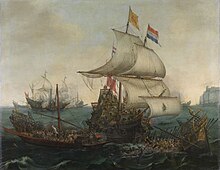
Dutch Ships Ramming Spanish Galleys off the Flemish Coast in Oct 1602, 1617, by Hendrick Vroom
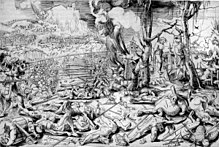
Especially in Northern Europe, small groups of soldiers became a pop subject for paintings and especially prints by many artists, including Urs Graf, who is unusual in that he was a professional Swiss mercenary for many years. These works began to present a less heroic view of soldiers, who frequently represented a considerable threat to civilian populations even in peacetime, though the extravagant costumes of the Landsknecht are often treated every bit glamorous.[11] For Peter Paret, from the Renaissance "the glorification of the temporal leader and of his political arrangement - which had of course also been nowadays in medieval art - replaces the Christian faith as a determining interpretive force" in armed services fine art.[12]
Naval painting became conventionalized in 17th century Dutch Golden Age painting, and from then on artists tended to specialize in it or not attempt it; apart from anything else "Marine artists accept always dealt with a particularly demanding form of patron", as JMW Turner found when the "Sailor Male monarch" William 4 of the Uk rejected his version of The Battle of Trafalgar because of inaccuracy. Hendrick Vroom was the earliest real specialist, followed past the male parent and son team of Willem van de Velde, who emigrated to London in 1673, and effectively founded the English language tradition of naval painting, "producing a stunning visual record of the Anglo-Dutch naval wars, which set the conventions of maritime battle painting for the next 150 years". Vroom had too worked for English patrons, designing a large set of tapestries of the defeat of the Spanish Armada which was destroyed when the Houses of Parliament burnt downward in 1834.[13]
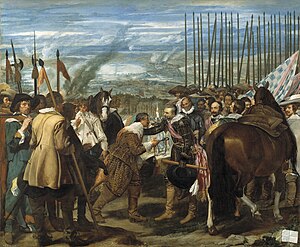
The 17th and 18th centuries saw depictions of battles mostly adopting a bird'due south eye view, as though from a hill nearby; this made them less interesting to paint, and the major artists now tended to avoid them. A very different view of warfare is seen in Les Grandes Misères de la guerre ("The Misfortunes of War"), a gear up of twelve etchings produced by Jacques Callot during the 30 Years War which follows a group of soldiers ravaging the countryside before eventually being rounded up by their own side and executed.[14] Also in the first half of the 17th century, a branch of genre painting in Dutch Golden Historic period painting specialized in guardroom scenes of rather disorderly soldiers, not often in boxing, but ransacking farmhouses or sitting around in a army camp guardroom.[fifteen] The paintings of Salvator Rosa, substantially landscapes, often showed groups variously described as bandits or soldiers lurking in the countryside of Southern Italian republic. The Surrender of Breda by Velázquez (1634–35) shows a crowded scene as the two sides run into peacefully to surrender the boondocks; a theme more ofttimes copied in naval painting than country-based armed forces art.[six]

From at least the late 15th century, sets of tapestries became the grandest medium for "official war machine art"; the Portuguese Pastrana Tapestries (1470s) were an early on example. A fix produced for the Duke of Marlborough showing his victories was varied for different clients, and even sold to one of his opponents, Maximilian 2 Emanuel, Elector of Bavaria, after reworking the full general's faces and other details.[16] [17]
In the mid-18th century, a number of artists, specially in Britain, sought to revive military art with large works centred on a heroic incident that would once again bring the genre to the fore in history painting, every bit it had been in the Renaissance. The standard contemporary battle scene tended to be grouped in the lowly category of topographical painting, covering maps and views of country houses. The Death of General Wolfe (1771) by Benjamin West, The Death of Helm James Cook (1779) by Johann Zoffany, The Defeat of the Floating Batteries at Gibraltar, September 1782 and The Expiry of Major Pierson (1784) by John Singleton Copley are leading examples of the new type, which ignored complaints about the unsuitability of mod apparel for heroic subjects. However such works had more immediate influence in France than in Britain.[18]
In the Napoleonic era, French republic added Romanticism to its way and began to portray individual soldiers with more than graphic symbol. Boxing paintings were increasingly produced for large public buildings, and grew larger than always before. Baron Gros painted more often than not glorifications of Napoleon and his victories, simply his 1808 painting of the Battle of Eylau does not neglect the suffering of the dead and wounded on the frozen battlefield.[19] In dissimilarity, Goya's big paintings The Second of May 1808 and The 3rd of May 1808, perhaps consciously conceived equally a riposte to Gros, and his related series of 82 etchings, The Disasters of State of war (Spanish: Los Desastres de la Guerra), emphasized the brutality of the French forces during the Peninsular War in Espana.[20] [21] British depictions of the Napoleonic Wars connected the late 18th century patterns, often on a larger scale, with the death of Admiral Horatio Nelson quickly producing large works by Arthur William Devis (The Death of Nelson, 21 October 1805) and West (The Death of Nelson). J. M. W. Turner was among the artists who produced scenes of Nelson'southward victories, with The Battle of Trafalgar.[22] The British Institution ran competitions for sketches of art commemorating British victories, the winning entries being then deputed.[23]

10th Regiment of Hussars, by Carle Vernet
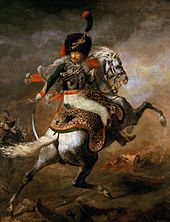
In this menstruum the uniform print, concentrating on a detailed depiction of the uniform of i or more standing figures, typically hand-coloured, also became very popular across Europe. Like other prints these were typically published in volume form, but also sold individually. In Britain the 87 prints of The Loyal Volunteers of London (1797–98) by Thomas Rowlandson, published past Rudolph Ackermann, marking the beginning of the archetype menstruation. Though Rowlandson usually satirized his subjects to some caste, hither the soldiers were "represented as they, and particularly their colonels who paid for their uniforms, preferred to run into themselves", which remained the usual depiction in such prints.[24] A set of prints by Carle Vernet of the fantabulous uniforms of La Grande Armée de 1812 showed nigh pes-soldiers in pairs in camp, in a variety of relaxed poses that showed one from the front and the other from behind. A rare oil painting by a leading artist that treats soldiers in the spirit of the uniform impress is Soldiers of the tenth Light Dragoons (the "Prince of Wales Own") painted in 1793 by George Stubbs for their Colonel in Chief, the future George IV of the United Kingdom. Other paintings of unmarried soldiers were more than dramatic, like Théodore Géricault's The Charging Chasseur (c. 1812).
Nineteenth century [edit]

Eugène Delacroix, who also painted many smaller combat scenes, finished his The Massacre at Chios in 1824, showing a then notorious assault on Greek civilians past Ottoman forces during the Greek War of Independence, who are shown in an entirely negative light. It had a more immediate bear upon on European art than Goya's Tres de Mayo (The Third of May 1808) of a few years earlier, which was obviously not even on brandish in the Prado Museum until some years later. In contrast, Delacroix's Liberty Leading the People of 1830 showed fighting in a positive lite, just not the "military" as it shows armed civilian revolutionaries of the July Revolution, advancing against the unseen uniformed forces of the government.[25] Turkish atrocities were to remain a recurrent theme in 19th-century painting, especially in former Ottoman territories escaped from the failing empire (often pre-rape scenes treated rather salaciously), and general anti-war machine sentiments, previously generally constitute in prints, were also to emerge regularly in large oil paintings.
War machine art remained popular during the remainder of the 19th century in most of Europe. French artists such every bit Ernest Meissonier,[26] Edouard Detaille,[27] and Alphonse de Neuville[28] established military genre painting in the Paris Salon.[29] New forms of military art which developed in the 1850s met considerable opposition from the Royal Academy in the Uk.[xxx]
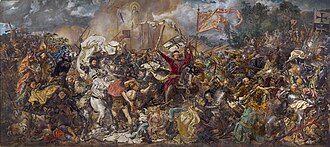
European artists in a generally academic style who were well known as painters of boxing scenes, still often of subjects from the Napoleonic Wars or older conflicts, included Albrecht Adam,[31] Nicaise de Keyser,[32] Piotr Michałowski[33] Antoine Charles Horace Vernet,[34] Emile Jean Horace Vernet,[35] Wilhelm Camphausen and Emil Hünten. The rise of nationalism promoted battle painting in countries such every bit Republic of hungary (cracking attention paid to uniforms), Poland (huge forces) and the Czech Lands. Jan Matejko'south enormous Boxing of Grunwald (1878) reflects Pan-Slav sentiment, showing various Slav forces joining together to boom the power of the Teutonic Knights.
The usage of the term "military art" has evolved since the middle of the 19th century. In French republic, Charles Baudelaire discussed military machine art, and the bear upon on it of photography, in the Paris Salon of 1859.[36] A British critic of the Royal Academy exhibition of 1861 observed that
British painters have never fully grappled with military fine art, they have just hovered around the edges, touching and trimming. -- William Michael Rossetti[37]

In contrast, the British artist Elizabeth Thompson (Lady Butler) explained that she "never painted for the glory of state of war, but to portray its pathos and heroism."[38] The backwash of battle was depicted in paintings like Calling the Roll After An Engagement, Crimea, which displayed at the Royal Academy in 1874. This perspective is likewise seen in Remnants of an Army which showed William Brydon struggling into Jalalabad on a dying horse. Dr. Brydon was the sole survivor of the 1842 retreat from Kabul, in which 16,000 were massacred by Afghan tribesmen.[39]

The British market began to develop in the middle of the 19th century.[40] The relations betwixt the state and its military, and the ideologies which are unsaid in that relationship affected the artwork, the artists and the public perceptions of both artwork and artists.[41]
By the time of the American Civil War and the Crimean War photographers began to compete strongly with artists in coverage of scenes in camp, and the aftermath of battle, simply exposure times were mostly likewise long to enable them to take pictures of battles very finer. War photography is not covered in this article. Illustrations for newspapers and magazines continued a heroic mode with perchance more than confidence than painters, and Melton Prior followed British forces around Imperial troublespots for decades, working for the Illustrated London News; his scenes "helped to constitute a style of activity draughtsmanship which has left an indelible stamp on the art of the comic strip."[42] Prior and other "special correspondents" such as Frederic Villiers were known as "specials". Richard Caton Woodville Jr. and Charles Edwin Fripp were "specials" and also painters who exhibited at the Purple University and elsewhere.[42]
Twentieth century [edit]
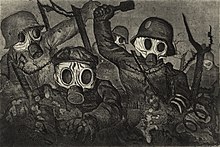
World War I very largely confirmed the finish of the glorification of state of war in art, which had been in pass up since the end of the previous century.[43] In general, and despite the establishment of big schemes employing official war artists, the near striking fine art depicting the state of war is that emphasizing its horror. Official state of war artists were appointed by governments for information or propaganda purposes and to record events on the battlefield;[44] simply many artists fought as normal soldiers and recorded their experiences at the time and afterwards, including the Germans George Grosz and Otto Dix, who had both fought on the Western Front, and connected to depict the subject for the rest of their careers. Dix'due south The Trench (1923), showing the dismembered bodies of the dead after an assail, caused a scandal, and was first displayed behind a drape, before causing the dismissal of the museum director who had planned to purchase it. Subsequently, after exhibiting it in their 1937 travelling exhibition of "Degenerate art", the Nazi government burnt information technology. He produced a set of 50 prints in 1924 on Der Krieg ("The War"). The English artist Paul Nash began to make drawings of the war while fighting on the Western Front in the Artists Rifles. After recovering from a wound he was recruited as an official war artist and produced many of the most memorable images from the British side of both World Wars. After the war, the huge demand for war memorials caused a boom for sculptors, covered beneath, and makers of stained-glass.
Posters had become universal by 1914 and were addressed at both the military and the "home front" for various purposes, including recruitment, where the British Lord Kitchener Wants You (not actually the slogan) was repeated in the Us with Uncle Sam, and elsewhere with similar totemic figures. The Soviet Union began with very Modernist posters such every bit Beat the Whites with the Red Wedge by Lazar Markovich Lissitzky but shortly turned to socialist realism, used for about Globe War Two posters from the Soviet Matrimony, which sometimes are similar to their Nazi equivalents. In World War 2 they were even more widely used.[45] Illustrators and sketch artists such as Norman Rockwell likewise followed the trend away from military machine themed shots following the Second World War and with the ascent of photographic covers in full general.
The touch on of the Castilian Civil State of war on a not-combatant populace was depicted in Picasso'due south masterpiece, Guernica, showing the bombing of Guernica in 1937;[46] a very dissimilar treatment of a similar subject is seen in Henry Moore's drawings of sleeping civilians sheltering from The Blitz bombing on the station platforms of the London Clandestine. Among official World State of war II war artists, Paul Nash's Totes Meer is a powerful image of a scrapyard of shot-down High german aircraft, and the landscapist Eric Ravilious produced some very fine paintings earlier being shot down and killed in 1942.[47] Edward Ardizzone's pictures concentrated entirely on soldiers relaxing or performing routine duties, and were praised past many soldiers: "He is the simply person who has caught the temper of this state of war" felt Douglas Cooper, the art critic and historian, friend of Picasso, then in a war machine medical unit.[48] Photography and film were now able to capture fast-moving activity, and tin fairly be said to accept produced most of memorable images recording combat in the war, and certainly subsequent conflicts similar the Vietnam State of war, which was more notable for specifically anti-war protest art, in posters and the piece of work of artists like Nancy Spero.[49] Contemporary military art is role of the subfield "military and popular culture".[fifty]
Fine art forms [edit]
Portraiture [edit]

Rulers have been shown in specifically military dress since ancient times; the difference is especially easy to run across in Aboriginal Roman sculpture, where generals and increasingly often emperors are depicted with armour and the short military tunic. Medieval tomb effigies more often than not draw knights, nobles and kings in armour, whether or not they saw active service. In the Early Modern menstruum, when senior commanders tended to wear their normal riding dress even on the battlefield, the stardom between a armed forces portrait and a normal one is generally conveyed by the background, or past a breastplate or the buff leather jerkin worn underneath armour, but in one case fifty-fifty generals began to clothing military uniform, in the mid-18th century, information technology becomes articulate once again,[51] although initially officeholder'southward uniforms were close to smart civilian costume.
Full-length and equestrian portraits of rulers and generals often showed them on the battleground, just with the action in the distant background; a characteristic probably dating back to Titian's magisterial Equestrian Portrait of Charles V, which shows the emperor after his victory at the Battle of Mühlberg simply with no other soldiers present. Monarchs were non often painted in armed services compatible until the Napoleonic period, but in the 19th century this became typical for formal portraits, maybe because uniform was more visually highly-seasoned. A distinctively Dutch type of painting are huge grouping portraits commissioned past the wealthy function-time officers of urban center militia companies, of which Rembrandt's Night Lookout man is much the virtually famous, although its narrative setting is atypical of the genre. Most examples just show the officers lined upward equally though about to eat dinner, and some show them really eating it.[52] Otherwise group portraits of officers are rather surprisingly rare until the 19th century.
Sculpture [edit]
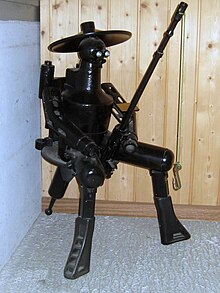
Sculpture fabricated from Swiss assault rifles Stgw 57
Most surviving sculpture of battle scenes from antiquity is in stone reliefs, covered above. Renaissance artists and patrons were groovy to revive this form, which they generally did in much smaller scenes in stone or statuary. The tomb in Milan of the brilliant French full general Gaston of Foix, Duke of Nemours included numerous marble reliefs round the base of operations of the sarcophagus (which was never completed). Statues and tomb monuments of commanders continued to exist the most common site until the more general state of war memorial commemorating all the dead began to emerge in the menses of the Napoleonic Wars. Nelson's Cavalcade in London still commemorates a unmarried commander; information technology has very large reliefs around the base by different artists, although these are generally regarded as less memorable than other aspects of the monument. Wellington's Column in Liverpool is also known as the "Waterloo Memorial", shifting to the more modern concept when "the expressionless were remembered essentially equally soldiers who fought in the name of national collectives".[53]
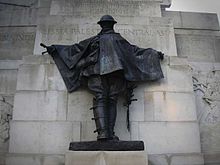
The huge losses of the American Ceremonious War saw the outset really big group of sculptural war memorials, every bit well equally many monuments for individuals. Amidst the most artistically outstanding is the Memorial to Robert Gould Shaw and the all-black 54th Regiment by Augustus Saint-Gaudens in Boston, with a 2nd cast in the National Gallery of Fine art, Washington. The even larger losses of World State of war I led even pocket-size communities in virtually nations involved to raise some course of memorial, introducing the widespread use of the course to Australia, Canada and New Zealand, the sudden increment in need leading to a blast for sculptors of public fine art. Even more than than in painting, the war brought a crunch in style, equally much public opinion felt the traditional heroic styles inappropriate. I of the near successful British memorials is the starkly realist Royal Arms Memorial in London, the masterpiece of Charles Sargeant Jagger, who had been wounded three times in the state of war and spent most of the adjacent decade commemorating it. In the defeated nations of Germany and Austria controversy, which had a political aspect, was especially fierce, and a number of memorials considered excessively modern were removed past the Nazis, whose own memorials, such every bit the Tannenberg Memorial were removed afterward World War II.[54] Other solutions were to make memorials more neutral, every bit in the repurposed Neue Wache in Berlin, since rededicated to different groups several times, and the dignified architectural forms of the Cenotaph in London (widely imitated) and the High german Laboe Naval Memorial; tombs of the Unknown Warrior and eternal flames were other means of avoiding controversy. Some, similar the Canadian National War Memorial, and most French memorials, were content to update traditional styles.[55]
A slap-up number of Globe State of war I memorials were simply expanded in scope to cover the dead of World War II, and often subsequent conflicts. The now dominant role of photography in depicting war is reflected in the National Iwo Jima Memorial, which recreates the iconic photograph Raising the Flag on Iwo Jima. The National D-Twenty-four hours Memorial, a project of the 1990s, includes strongly realist sculpture, in contrast to the Vietnam Veterans Memorial in Washington. More innovative memorials have often been erected for the noncombatant victims of war, above all those of the Holocaust.[56]
Scope [edit]
Peacetime [edit]

Rice distribution at Carrefour in Haiti after the earthquake in 2010. Oil sketch by Sgt. Kristopher Battles, USMC
Military art encompasses actions of military forces in times of peace. For example, USMC Sgt. Kristopher Battles, the merely remaining official American war artist in 2010, deployed with American forces in Haiti to provide humanitarian relief equally part of Performance Unified Response afterward the disastrous earthquake in 2010.[57]
Wartime [edit]

Canadian Gunners in the Mud, Passchendaele by Lieutenant Alfred Bastien, 1917, oil on canvas. Bastien depicts a group of gunners struggling to release 1 of their guns from the mud. The focus on the gun, rather than on the soldiers, underlines the importance of this weapon to success on the battlefield. -- Canadian War Museum
Purpose [edit]
War art creates a visual business relationship of military machine conflict by showing its touch as men and women are shown waiting, preparing, fighting, suffering, and celebrating.[58] [59]The subjects encompass many aspects of war, and the individual's experience of war, whether allied or enemy, service or civilian, military or political, social or cultural. The thematic range embraces the causes, course and consequences of disharmonize.[60]
State of war art, a significant expression of any civilisation and its significant legacies, combines artistic and documentary functions to provide a pictorial portrayal of state of war scenes and prove "how war shapes lives."[lx] [61] [62] [63] [64] It represents an attempt to come to terms with the nature and reality of violence.[65] War art is typically realistic, capturing factual, eyewitness detail too as the emotional impression and impact of events.[66] Fine art and war becomes "a tussle between the earth of the imagination and the world of activeness" — a constant tension between the factual representation of events and an artist'due south interpretation of those events.[67]
Part of the tussle includes determining how best to illustrate complex state of war scenes. C.E.W. Bean'southward Anzac Book, for example, influenced Australian artists who grew up betwixt the ii globe wars. When they were asked to describe a second multi-nation war after 1939, there was a precedent and format for them to follow.[68]
State of war fine art has been used as an instrument of propaganda, such as a nation-building function or other persuasive ends.[63] [69] [70] War art is also captured in caricature, which offers gimmicky insights.[71] Western Civilization and artful tradition were both clearly marked by military conflicts throughout history. War drove culture and civilisation drove war. The legacy of state of war inspired artworks reads like a series of mile markers, documenting the meandering form of civilization's evolutionary map.[72]
War artists [edit]
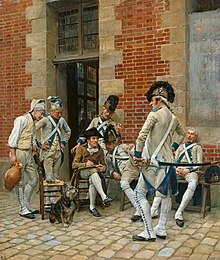
War artists may be involved equally onlookers to the scenes, military personnel who respond to powerful inner urges to depict direct war experience, or individuals who are officially commissioned to be present and record war machine activity.[73]
Every bit an instance of nation's efforts to document state of war events, official Japanese war artists were deputed to create artwork in the context of a specific war for the Japanese government, including sensō sakusen kirokuga ("state of war entrada documentary painting"). Between 1937 and 1945, approximately 200 pictures depicting Japan's military campaigns were created. These pictures were presented at large-scale exhibitions during the war years; Afterwards the finish of World War Ii, Americans took possession of Japanese artwork.[74] [75] [76]
There are some who may choose not to create state of war art. During the course of World War Two, the Italians created virtually no art which documented the disharmonize. The French began to paint the war merely after the war was ended in 1945.[77]
Classical examples [edit]
Examples of classical state of war art include the friezes of warriors at the Temple of Aphaia in Greece or the Bayeux Tapestry, is a linear panoramic narrative of the events surrounding the Norman Conquest and the Battle of Hastings in 1066.[nine] [78]
Gallery [edit]


The Room in the McLean Business firm, at Appomattox C.H., in which Gen. Lee surrendered to Gen. Grant, April 9, 1865. This lithograph of the issue shows the 2 men every bit they waited for the peace terms to be copied.
Officers shown hither
Portraits, left to right: John Gibbon, George Armstrong Custer, Cyrus B. Comstock, Orville E. Babcock, Charles Marshall, Walter H. Taylor, Robert Due east. Lee, Philip Sheridan, Ulysses S. Grant, John Aaron Rawlins, Charles Griffin, unidentified, George Meade, Ely S. Parker, James Westward. Forsyth, Wesley Merritt, Theodore Shelton Bowers, Edward Ord. The man not identified in the moving-picture show'south fable is thought to be Full general Joshua Chamberlain, who presided over the formal surrender of arms past Lee's Regular army of Northern Virginia on April 12, 1865.

Marines lug their packs out to the waiting helo in Republic of haiti in 2010. Sketch by Battles, USMC


"Great achievements of the Communist china in the past 3 years" (334,053,057 people supporting a P5 peace treaty, mass donation worth 3,710+ fighters, 570,000+ enemy casualties including 250,000+ American invaders), a affiche in mainland People's republic of china about the Korean War, circa 1950s
Cavalry [edit]
-

Bercheny's Hussars, French lite cavalry, 1776.
-
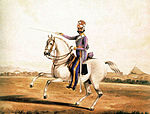
Portrait of a mounted Sowar of the sixth Madras Light Cavalry, circa 1845.
-

-

-

-

Offering a drink of water to a fallen soldier [edit]
-

Sketch showing American POWs in a Japanese prison camp in the Philippines, 1945
River crossings [edit]

Propaganda [edit]
-

The Adult female'south Land Army of America, US, 1918
-

Our boys need sox - knit your bit, US, 1917-1918
-

Victory garden poster, The states, 1945
See also [edit]
- State of war artists
- American official war artists
- Australian official war artists
- British official war artists
- Canadian official war artists
- German official state of war artists
- Japanese official war artists
- New Zealander official war artists
- Heraldry
- The Horse in Art
- Militaria
- War photography
- War rugs, a contempo tradition of Afghanistan
Notes [edit]
- ^ "War art" in the Oxford Companion to War machine History, on Answers.com, and the article by Richard Woodward on "Military artists" in the aforementioned work (penultimate paragraph); note that the term does not appear at all in Grove Art Online, or other large art reference works. As formal "wars" have largely vanished, "combat artist" seems to be replacing "war artist" in official employ.
- ^ Pepper, Introduction
- ^ Strudwick (2005), p. 371
- ^ Bakery (2008), p. 84
- ^ Rawson, 103
- ^ a b c "Military Artists" in the Oxford Companion to Armed services History, on Answers.com
- ^ a b Pepper, 1 (i)
- ^ Schapiro, 153
- ^ a b UNESCO Archived 2012-02-17 at the Wayback Machine, Bayeaux tapestry, Nomination Course, p. 4; excerpt,"... it is an established fact that it recounts a armed forces triumph: the conquest of England past William the Conqueror"; Nomination Grade, pp. 5-half-dozen; excerpt, "This large-scale fabric work of the 11th century is, to our knowledge, the only ane of its kind to have survived to the nowadays day. The Tapestry is an almost contemporary visual record of the consequence it depicts, one of the most significant events of Medieval times. It tells of the ancestry of the Norman Conquest; the landing of Norman and French troops in England and the Battle of Hastings"
- ^ Hartt, 457 on Leonardo (quoted), 470-471 on Michelangelo, 246-248 on Uccello.
- ^ Pepper, 1 (iii), Kettering, 104
- ^ Paret, 13
- ^ Pepper, 3 (i) quoted on patrons; two (2) quoted on van de Veldes; Slive, Chapter 9.
- ^ Becker, 155-156; "Military Artists" in the Oxford Companion to Military History, on Answers.com
- ^ Pepper, 2 (i); Kettering, 104-109
- ^ Pepper, two (i)
- ^ 1704 Battle of Blenheim depicted in tapestry at Blenheim Palace
- ^ Hichberger, ten-11
- ^ Norman, Geraldine. (1977). "Gros, Baron Antoine Jean", Nineteenth-century Painters and Painting: A Dictionary, p. 100., p. 100, at Google Books
- ^ Pepper, 3 (ii); Laurels & Fleming, 483
- ^ Norman, "Goya y Lucientes, Franciso José de", p. 99., p. 99, at Google Books
- ^ Pepper, 3 (i)
- ^ Hichberger, 14-28
- ^ Russell, 73-74, quoting Ford's history of the Ackermann firm.
- ^ Honor and Fleming, 487-488
- ^ Norman, "Messonier, Jean Louis Ernest", p. 145., p. 145, at Google Books
- ^ Norman, "Detaille, Jean Baptiste Edouard", p. 73., p. 73, at Google Books
- ^ Norman, "Neuville, Alphonse Marie de", p. 159., p. 159, at Google Books
- ^ Sullivan, A.Eastward. (1958). "Military Art and Artists", Ground forces Quarterly and Defence Journal, Vol. 76-77, pp. 235-236; excerpt, "A collaborator of Detaille, and like him a specialist in armed forces art, was Alphonse de Neuville (1836–1885), who made his debut at the Salon in 1859 with a scene showing a French bombardment at Sebastapol."
- ^ Hichberger, pp. 58., p. 58, at Google Books
- ^ Norman, "Albrecht, Adam", p. 28., p. 28, at Google Books
- ^ Norman, "Keyser, Nicaise de", p. 120., p. 120, at Google Books
- ^ Norman, "Michalowski, Piotr", p. 120., p. 120, at Google Books
- ^ Norman, "Vernet, Antoine Charles Horace", p. 211., p. 211, at Google Books
- ^ Norman, "Vernet, Emile Jean Horace", p. 212., p. 212, at Google Books
- ^ Paret, Peter (1997). Imagined Battles. Reflections of State of war in European Art, p. 85., p. 85, at Google Books, citing Charles Baudelaire. (1992). "The Salon of 1859", Selected Writings on Art and Literature, trans. P. E. Charvet, pp. 295, 297; extract, "In a section preceding the word of military art in his articles on the Salon of 1859, Baudelaire discussed the advent of photography and its impact on fine art."
- ^ Hichberger, pp. 68-69., p. 68, at Google Books; the term armed forces art is not a neologism
- ^ Mcintyre, Ben. September ten, 2009 "Pictures of war tin can bear more than moral meaning than thousands of words," The Times (London). September 10, 2009.
- ^ McIntyre, "Pictures," September 10, 2009; "The Disasters in Afghanistan," The Times. April 7, 1842.
- ^ Hichberger, p. 71., p. 71, at Google Books
- ^ Hichberger, p. 2-iii., p. 2, at Google Books
- ^ a b Pepper, 3, (ii)
- ^ Pepper, Introduction and 3, ii
- ^ National Archives (UK), "'The Art of War,' Learn Most the Fine art."
- ^ James covers all major combatant nations of World War I; for British Earth War Two posters, and a wider bibliography, see Weapons on the Wall in external links
- ^ Walker, William. The Lessons of Guernica," Archived 2010-12-04 at the Wayback Machine Toronto Star. February 9, 2003.
- ^ Brandon, 66
- ^ Foss, 123
- ^ Brandon, 77-83
- ^ Ender M.G., Reed B.J., Absalon J.P. (2020) Popular Civilisation and the Military. In: Sookermany A. (eds) Handbook of Military Sciences. Springer, Cham. https://doi.org/10.1007/978-3-030-02866-4_36-ane https://link.springer.com/referenceworkentry/10.1007/978-iii-030-02866-4_36-1
- ^ Kettering, 100
- ^ Slive, 250-251
- ^ Carrier, xviii
- ^ Mosse, 97–98
- ^ Mosse, 103–106 on conservatism, and generally throughout Chapter 5 on war memorials.
- ^ Carrier, throughout. His Chapter one gives an overview of the written report of 19th and 20th century memorials
- ^ Kino, Carol. "With Sketchpads and Guns, Semper Fi"; "Marine Art," New York Times. July 13, 2010; Sketchpad Warrior web log, "It's All in the Wrist", May 25, 2010.
- ^ Canadian War Museum (CWM), "Australia, Britain and Canada in the Second Globe War," 2005.
- ^ Hichberger, J.Due west.M. (1991). Images of the Army: The Armed services in British Art, 1815–1914, pp. 12-13., p. 12, at Google Books; Brandon, Laura. (2008). Art and State of war, pp. 4-9., p. 4, at Google Books
- ^ a b Imperial War Museum (IWM), Well-nigh the Regal War Museum Archived 2010-12-05 at the Wayback Machine
- ^ Brandon, Laura. (2008). Art and War, p. 4., p. 4, at Google Books
- ^ Foss, p. 131., p. 131, at Google Books
- ^ a b Foss, Brian. (2006). War Paint: Art, War, State, and Identity in Britain, 1939-45, p. 157., p. 157, at Google Books; extract, "records that were as much artistic as documentary."
- ^ Maenius, Chase (2015). 13 Masterpieces. Underground Media. pp. 27–29. ISBN978-1320309554.
- ^ Foss, p. 124., p. 124, at Google Books
- ^ Foss, p. 134., p. 134, at Google Books
- ^ Gough, Paul. (2010) A Terrible Beauty: British Artists in the First Globe War, p. 3.
- ^ Reid, John B. (1977). Australian Artists at State of war, Vol. ii, p. 5; excerpt, "The Australian people first became familiar with Australasian state of war art as a genre with the publication of the and then-chosen 'Christmas books' ... which independent the writings of servicemen and were illustrated past the current state of war artists."
- ^ Brandon, p. half dozen., p. 6, at Google Books
- ^ Brandon, p. 58., p. 58, at Google Books
- ^ ASKB, Caricature
- ^ Chase Maenius. The Art of War[due south]: Paintings of Heroes, Horrors and History. 2014. ISBN 978-1320309554
- ^ Oxford Companion to War machine History
- ^ McCloskey, Barbara. (2005). Artists of Earth War II, pp. 111-126.
- ^ Tsuruya, Mayu. "Cultural Significance of an Invisible Emperor in Sensô Sakusen Kirokuga ('War Campaign Documentary Painting')." Association for Asian Studies (AAS), Annual Meeting (Boston, Massachusetts), March 22–25, 2007.
- ^ Nara, Hiroshi. (2007). Inexorable Modernity: Japan'south Grappling with Modernity in the Arts, p. 97 n47., p. 97, at Google Books
- ^ Ross, Alan. (1983). Colours of War, p. 118.
- ^ Stover, Eric et al. (2004). My Neighbour, my Enemy, p. 271., p. 271, at Google Books
References [edit]
- Bakery, Darrell (2008). The Encyclopedia of the Pharaohs: Volume I – Predynastic to the Twentieth Dynasty 3300–1069 BC. Stacey International. ISBN 978-1-905299-37-9
- DP Becker in KL Spangeberg (ed), Vi Centuries of Main Prints, Cincinnati Art Museum, 1993. ISBN 0-931537-15-0
- Brandon, Laura. (2008). Art and War. New York: I.B. Tauris. ISBN 978-ane-84511-237-0; OCLC 225345535
- Carrier, Peter. Holocaust monuments and national memory cultures in France and Frg since 1989: the origins and political role of the Vél' d'Hiv' in Paris and the Holocaust Monument in Berlin, Berghahn Books, 2006, ISBN 1-84545-295-X, 9781845452957
- Foss, Brian. (2006). State of war Paint: Art, State of war, State, and Identity in Britain, 1939-45. New Oasis: Yale University Press. ISBN 978-0-300-10890-3; OCLC 166478725
- Gough, Paul. (2010). A Terrible Dazzler: British Artists in the Starting time World War. Bristol: Sansom & Co. ISBN 9781906593001; OCLC 559763485
- Hartt, Frederick, History of Italian Renaissance Art, (2nd edn.)1987, Thames & Hudson (U.s.a. Harry Northward Abrams), ISBN 0-500-23510-4
- Hichberger, J.Westward.M. (1991). Images of the Army: The Armed forces in British Art, 1815–1914. Manchester: Manchester Academy Printing. ISBN 978-0-7190-2675-ane; OCLC 232947212
- Holmes, Richard. (2003). The Oxford Companion to Military History. Oxford: Oxford University Printing. ISBN 978-0-19-860696-3; OCLC 231975512
- Hugh Honour and John Fleming, A Globe History of Fine art, 1st edn. 1982 & many subsequently editions, Macmillan, London, page refs to 1984 Macmillan 1st edn. paperback. ISBN 0-333-37185-2
- James, Pearl. Picture this: World State of war I posters and visual culture, 2010, University of Nebraska Press, ISBN 0-8032-2610-1, ISBN 978-0-8032-2610-4, [1]
- Kettering, Alison McNeal. Gerard ter Borch's Armed forces Men; Masculinity Transformed, in The public and private in Dutch culture of the Golden Age, Arthur K. Wheelock, Adele F. Seeff (eds), 2000, Academy of Delaware Press, ISBN 0-87413-640-7, ISBN 978-0-87413-640-1
- Maenius, Chase. "13 Masterpieces". Underground Media Publishing, 2015. ISBN 1320309550
- McCloskey, Barbara. (2005). Artists of World War II. Westport: Greenwood Press. ISBN 978-0-313-32153-v; OCLC 475496457
- Mosse, Fallen Soldiers: Reshaping the Memory of the World Wars. Oxford University Press United states, 1991. ISBN 0-19-507139-5, ISBN 978-0-nineteen-507139-nine
- Nara, Hiroshi. (2007). Inexorable Modernity: Japan's Grappling with Modernity in the Arts.Lanham, Maryland: Lexington Books. ISBN 978-0-7391-1841-2; ISBN 978-0-7391-1842-9; OCLC 238825589
- Norman, Geraldine. (1977). Nineteenth-Century Painters and Painting: a Dictionary. Berkeley: Academy of California Press. ISBN 978-0-520-03328-3; OCLC 300187133
- Pepper, Simon. "Battle pictures and armed forces scenes", in Grove Art Online (restricted access, refs to sections), accessed March 22, 2011
- Rawson, Jessica (ed). The British Museum Book of Chinese Art, 2007 (second edn), British Museum Press, ISBN 978-0-7141-2446-9
- Paret, Peter (1997). Imagined Battles. Reflections of War in European Art. Chapel Colina: University of Due north Carolina. ISBN 978-0-8078-2356-9; OCLC 260076007
- Reid, John B. (1977). Australian Artists at War: Compiled from the Australian War Memorial Collection. Book 1. 1885–1925; Vol. ii 1940–1970. South Melbourne, Victoria: Sun Books. ISBN 978-0-7251-0254-8; OCLC 4035199
- Ross, Alan. (1983). Colours of State of war: War Art, 1939-45. London: J. Cape. OCLC 122459647
- Russell, Ronald, Discovering Antiquarian Prints, Osprey Publishing, 2001, ISBN 0-7478-0499-0, ISBN 978-0-7478-0499-four, [2]
- Schapiro, Meyer, The Religious Meaning of the Ruthwell Cantankerous (orig. 1944), in Selected Papers, volume 3, Late Antique, Early Christian and Mediaeval Art, 1980, Chatto & Windus, London, ISBN 0-7011-2514-4
- Slive, Seymour Slive. Dutch Painting, 1600–1800, Yale Upwards, 1995,ISBN 0-300-07451-4
- Stover, Eric and Harvey M. Weinstein. (2004). My Neighbor, my Enemy: Justice and Community in the Aftermath of Mass Atrocity. Cambridge: Cambridge University Press. ISBN 978-0-521-83495-seven; ISBN 978-0-521-54264-7; OCLC 183926798
- Strudwick, Nigel C. (2005). Texts from the Pyramid Age. Writings from the Ancient World (volume 16). Atlanta: Society of Biblical Literature. ISBN 978-one-58983-680-8
- Tsuruya, Mayu. (2005). Sensô Sakusen Kirokuga ("State of war Campaign Documentary Painting"): Japan's National Imagery of the 'Holy War', 1937-1945. Ph.D. dissertation, University of Pittsburgh.
Further reading [edit]
- Binek, Lynn K. and Walter A Van Horn. (1989). Drawing the Lines of Battle : Military Fine art of World State of war Ii Alaska. Anchorage, Alaska: Anchorage Museum of History and Art. OCLC 20830388
- Carman, Westward. Y. (2003). The Ackermann war machine prints: uniforms of the British and Indian armies, 1840–1855. Atglen, Pennsylvania: Schiffer Pub. ISBN 0-7643-1671-0
- Cork, Richard. 1994. A Bitter Truth: Avant-garde Fine art and the Great War. New Oasis: Yale University Press. ISBN 978-0-300-05704-i; OCLC 185692286
- Human foot, Michael Richard Daniel. (1990). Art and war: twentieth century warfare every bit depicted past war artists. London: Headline. ISBN 978-0-7472-0286-8; OCLC 21407670
- Gilkey, Gordon. State of war Art of the 3rd Reich. Bennington, Vermont: International Graphics Corporation, 1982. 10-I
- Gallatin, Albert Eugene. (1919). Art and the Great War. New York: East.P. Dutton. OCLC 422817
- Hale, John (1990). Artists and Warfare in the Renaissance. New Haven: Yale Academy Press. ISBN 0-300-04840-8.
- Hodgson, Pat (1977). The War Illustrators. London: Osprey. OCLC 462210052
- Johnson, Peter (1978). Front-Line Artists. London: Cassell. ISBN 978-0-304-30011-two; OCLC 4412441
- Jones, James (1975). WW II: a Chronicle of Soldiering. New York: Grosset & Dunlap. 1617592
- Lanker, Brian and Nicole Newnham. (2000). They Drew Fire: combat artists of World War II. New York: Goggle box Books. ISBN 978-one-57500-085-five; OCLC 43245885
- Hunt Maenius. The Fine art of War[s]: Paintings of Heroes, Horrors and History. 2014. ISBN 978-1320309554
- Nevill, Ralph and William Gladstone Menzies. (1909). British Armed forces Prints. London: The Connoisseur Publishing. OCLC 3509075
- Prendergast, Christopher (1997). Napoleon and history painting: Antoine-Jean Gros's La Bataille d'Eylau. Oxford: Oxford University Printing. ISBN 978-0-19-817402-8; ISBN 978-0-nineteen-817422-6; OCLC 35777393
- Australia
- Reid, John B. (1977). Australian Artists at State of war: Compiled from the Australian War Memorial Collection. Volume one. 1885–1925; Vol. two 1940–1970. South Melbourne, Victoria: Lord's day Books. ISBN 978-0-7251-0254-8; OCLC 4035199
- Canada
- Brandon, Laura (2021). State of war Art in Canada: A Disquisitional History. Toronto: Art Canada Establish, 2021. ISBN 978-ane-4871-0271-5
- Oliver, Dean Frederick, and Laura Brandon (2000). Sheet of War: Painting the Canadian Experience, 1914 to 1945. Vancouver: Douglas & McIntyre. ISBN 978-ane-55054-772-6; OCLC 43283109
- Tippett, Maria. (1984). Art at the Service of War: Canada, Art, and the Great War. Toronto: University of Toronto Printing. ISBN 978-0-8020-2541-eight; OCLC 13858984
- Germany
- Gilkey, Gordon. War Art of the Tertiary Reich. Bennington, Vermont: International Graphics Corporation, 1982. ISBN 978-0-86556-018-five; OCLC 223704492
- Weber, John Paul. (1979). The German War Artists. Columbia, South Carolina: Cerberus. ISBN 978-0-933590-00-7; OCLC 5727293
- Yenne, William P. (1983). High german State of war Art, 1939-1945. New York: Crescent Books. ISBN 978-0-517-34846-eight; OCLC 611620194
- Japan
- Nussbaum, Louis Frédéric and Käthe Roth. (2005). Japan Encyclopedia. Cambridge: Harvard University Press. ISBN 978-0-674-01753-5; OCLC 48943301
- Okamoto, Shumpei and Donald Keene. (1983). Impressions of the Front end: Woodcuts of the Sino Japanese State of war, 1894-95. Philadelphia: Philadelphia Museum of Art. OCLC 179964815
- New Zealand
- Haworth, Jennifer. (2007). The Art of War: New Zealand War Artists in the Field 1939-1945. Christchurch, New Zealand: Hazard Press. ISBN 978-i-877393-24-2; OCLC 174078159
- South Africa
- Carter, Albert Charles Robinson. (1900). The Work of War Artists in Due south Africa. London: "The Art Journal" Office. OCLC 25938498
- Huntingford, N. P. C. (1986). A Option of South African Military art, 1939–1945, 1975–1985. Pretoria : Armed services Fine art Informational Board, Defence Headquarters. OCLC 79317946
- Ukraine
- Еволюція воєнного мистецтва: у 2 ч. / Д. В. Вєдєнєєв, О. А. Гавриленко, С. О. Кубіцький та ін.; за заг. ред. В. В. Остроухова. – К.: Вид-во НА СБУ, 2017.
- United Kingdom
- Gough, Paul. (2010). A Terrible Beauty: British Artists in the Kickoff World War. Bristol: Sansom and Company. ISBN 978-1-906593-00-ane; OCLC 559763485
- Harries, Meirion and Suzie Harries. (1983). The War Artists: British Official War Fine art of the Twentieth Century. London: Michael Joseph. ISBN 978-0-7181-2314-7; OCLC 9888782
- Harrington, Peter. (1983). British Artists and War: The Face up of Battle in Paintings and Prints, 1700–1914. London: Greenhill. ISBN 978-1-85367-157-ix; OCLC 28708501
- Haycock, David Boyd. (2009). A Crisis of Brilliance: Five Young British Artists and the Great War. London: Sometime Street Publishing. ISBN 978-1-905847-84-6; OCLC 318876179
- Sillars, Stuart (1987). Art and Survival in Beginning Globe War Britain. New York: St. Martins Printing. ISBN 978-0-312-00544-3; OCLC 14932245
- Holme, Charles. (1918). The war depicted by distinguished British artists. London: The Studio. OCLC 5081170
- Thorniley-Walker, Jane. (2006). State of war Art: Murals and Graffiti - War machine Life, Power and Subversion. Bootham: Council for British archaeology. ISBN 978-1-902771-56-iv; OCLC 238785409
- United States
- Cornebise, Alfred. (1991). Art from the trenches: America'south Uniformed Artists in World War I. Higher Station: Texas A & 1000 University Printing. ISBN 978-0-89096-349-iv; OCLC 22892632
- Dempsey, L James. (2007). Blackfoot War Art: Pictographs of the Reservation Menstruation, 1880-2000. Normanm Oklahoma: University of Oklahoma Press. ISBN 978-0-8061-3804-6; OCLC 70839712
- Foley, William A. (2003). Visions from a Foxhole: a rifleman in Patton's Ghost Corps. NY: Ballantine ISBN 9780891418122 plus Artist Interview about experience and exhibit at the Pritzker Military Library from January 22-April 9, 2010
- Gilkey, Gordon. State of war Fine art of the Third Reich. Bennington, Vermont: International Graphics Corporation, 1982). x-I
- Harrington, Peter, and Frederic A. Sharf. (1988). A Splendid Picayune War; The Spanish–American War, 1898; The Artists' Perspective. London: Greenhill. ISBN 978-1-85367-316-0; OCLC 260112479
External links [edit]
 | Wikimedia Commons has media related to State of war in art. |
- Regular army art of World War I. United States Army Center of Military History : Smithsonian Institution, National Museum of American History. 1993. Prints bachelor online through the Washington State Library's Classics in Washington History collection
- State of war Art, 1500 New Zealand art works online
- Mémorial de Caen, 1914-1918 war, Artists of the Showtime World War
- Ministry of Defence (Mod), Modernistic art drove, war artists
- National Athenaeum (UK), The Art of War
- Aviation and Armed forces fine art at Curlie
- Anne S. Chiliad. Dark-brown Military Collection, Brown University Library
- Weapons on the Wall, British Earth State of war Two posters
- Athenaeum New Zealand, War Art digitization
Source: https://en.wikipedia.org/wiki/Military_art
0 Response to "Popular Works of Art in the 19th Century Prior to Wwi"
Post a Comment